
Remember, Remember
An English folk festival from the old days

This piece of writing started out as a comment for the marvellous Jenna Woginrich in response to her post, “The War On Halloween”. It quickly grew and grew until it had to be a post of its own. If you get any satisfaction from this post, or even if you don’t, check her out!
Guy Fawkes Night, November 5th, was the highlight of my autumn. Back in the England, particularly southern England, particularly Sussex, of the sixties and seventies, Halloween just wasn’t a thing. I had seen a drawing in Look and Learn, the posh kids’ comic often found in doctors’ or dentists’ waiting rooms, of apple bobbing, but I didn’t know anyone who did that. No, Fawkesmania was where it was at, and fireworks were a principal part of its pleasure.
Fireworks went on sale at least a month before the big day, and you could buy them at pocket money prices from your local newsagent. I was an avid collector, even making lists of my stock. Friends brought their own fireworks along to our bonfire parties. It was always exciting to see what they had: our local sellers only sold Brocks (of Hemel Hempstead, the oldest British fireworks company), but our friends would often have Standard (of Huddersfield) which we had seen on television (“Light up the sky with Standard fireworks!”).
Actually, the phrase our firework parties I wrote in the paragraph above has made me stop and stare, because I have realised that the parties were the only time I can recall social occasions at my home. My younger brother and I were brought up in a semi-detached, two-bedroom bungalow in Worthing, the most boring place in the world, that had been constructed for the needs of retiring pensioners, not young families. But my parents had bought it new. That was all they could afford.
You could hardly swing a conductor’s baton, let alone a cat, inside the house. But it came with a really big garden, which was on two levels, which made it prime Guy Fawkes venue potential. So we did the fireworks display on the top lawn. And we built the bonfire in the lower vegetable garden, which was lying fallow at this time of the year.
Figures in threadbare jackets, mouldy jeans and desultory masks were a frequent feature of shopping streets in late October, and requests for “Penny for the Guy?” accompanied these effigies. We didn’t do that, but we did have a Guy made to much the same standards, placed on quite a big bonfire in the late afternoon of November 5th. One year my dad tried to ignite said bonfire by firing an flaming arrow at it. Perhaps he had been inspired by the TV show The Golden Shot1. I don’t remember that as being a success. Neither were our attempts to cook jacket potatoes in the bonfire; they were incinerated long before we could have buttered them. The bonfire was h-o-t; you couldn’t have got near it.
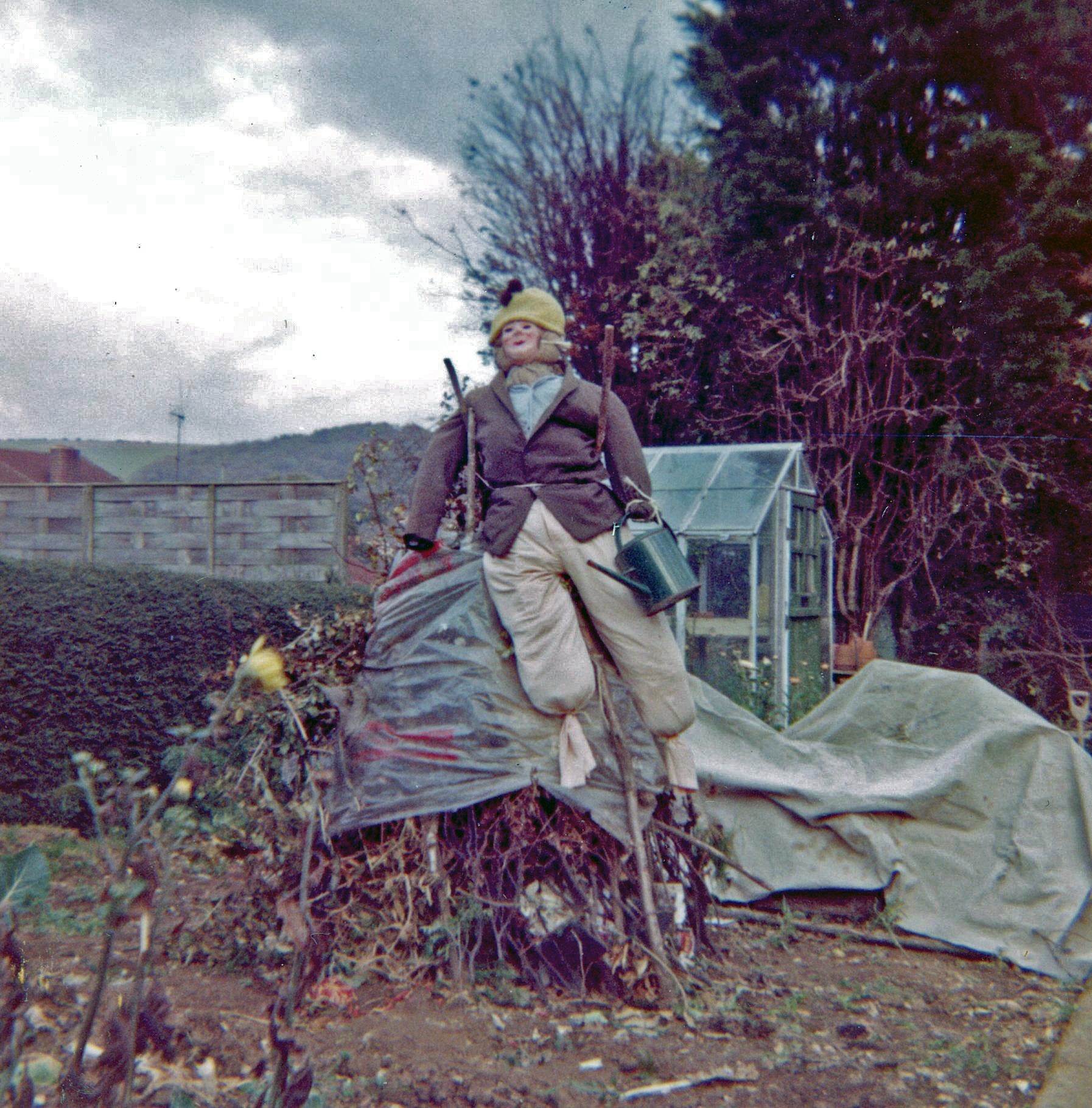
Our bonfire and guy, c.1968
We tried to set the fireworks off in ascending order of price (1d, 2d, 3d etc - it was pre-decimal money back then folks) so far as we could make out by torchlight. This was generally a good method but every so often a firework would disappoint in its performance, provoking a general groan from the audience, or not go off at all. Never return to a lighted firework! (a maxim not always observed). At the bottom end were bangers (which banged) and jumping jacks. The latter were basically extended bangers with knots: you lit one, retired quickly, and it banged. The explosion made the firework move (it’s dark, where has it gone?) and it would bang again somewhere else. And again. And maybe again.
The main menu consisted of variants on the roman candle theme (things like burning bush or the similarly unfortunately named golden showers (not that we knew about that sort of thing back then). Catherine wheels2 were nailed to a post and could create psychedelic effects as they blazed round and round. Rockets were expensive and usually ended the display. One year I remember a firework which was a kind of a cross between a rocket and a catherine wheel, called Hovercraft3 or something like that. It worked extremely well, in fact too well, arcing a couple of times across the garden before landing on a plastic roof.
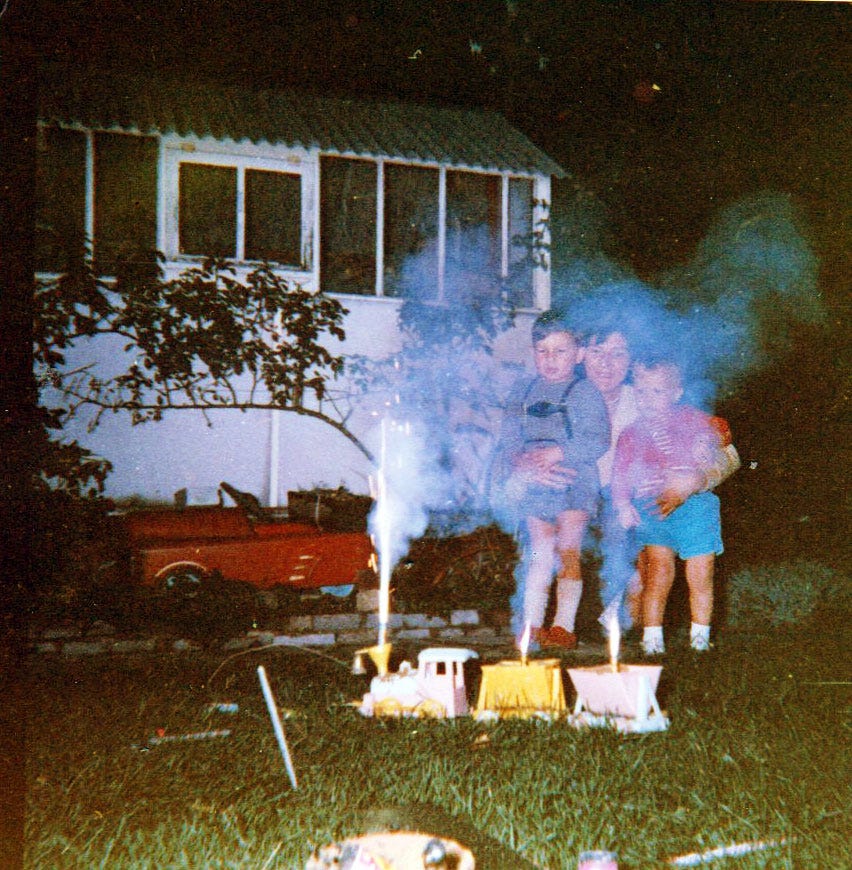
We have retired quickly, but not very far. Some small Brocks’ fireworks which my dad had decided to let off in a plastic train, which did not survive the experience. From left: the author, my mum and my little brother. What. Was. I. Wearing? Genuine German lederhosen as given me by my German godmother. None of us liked it so it was kept for wear in the garden etc..
Fun memories. Innocent, of course. We had all heard a bowdlerised version of the Guy Fawkes story, in which the Catholic-plot aspect of the tale was excised. I had even acted in a Guy Fawkes play at Sunday school (I think I might have been Robert Catesby). Guy Fawkes Night in many ways is a typically ambiguous English institution. Are we celebrating that he failed to blow up Parliament, or that at least he tried to blow it up (it was only the House of Lords that was targeted, after all)? The Bonfire Boys were a intermittently unruly group that could be found right across Sussex in the nineteenth century, including in Worthing, and I’m sure their hand was faintly on our tiller in the 1960s. Like most marginal groups it’s hard to tie them down, politically. There was an element of proto-class war about them. But they were also anti-Catholic. Ian Paisley4 was associated with the Lewes Bonfire Night (the biggest public Guy Fawkes event) in the 1970s. That aura of ‘No Popery’ has fortunately been sanitised.
Because Guy Fawkes has been sanitised too. Religion aside, it was concerns of safety wot did it. Even in my childhood there were frequent stories of children or adults being disfigured by faulty fireworks or just getting too close to them. There were public information films on firework safety on the television. My teacher (in modern-day year 5) proselytised against fireworks, but she just came across as a middle-class do gooder who brought out the Bonfire Boy in me.
Being entertained by fireworks in a modest setting in Worthing, however, is not the same thing as using them to terrorise people in inner-city areas; but the fireworks were just as easy to buy anywhere, and for whatever purpose. Often it was black and Asian people who were targeted, and this kind of racism, because it was spectacular, did receive some coverage even in the Daily Mail. Many people sealed their letterboxes shut in October and November. And dogs’ lives were made an autumnal misery.
Private firework displays still happened through the 1980s - I organised one in my shared house in Bow in 1987, though it was largely an excuse for a booze-up - but the trend was strongly towards public-only displays, which meant more or complete safety but definitely less thrills. Gone are the days of the modest roman candle: it’s heavy metal stuff now, but from a distance, very often accompanied by music which is ok if you like the music they pick which I generally don’t (clue: it’s rarely the Music for the Royal Fireworks). Halloween is more popular now, albeit in a version re-imported from America which lacks the cultural history, in the south of England; it’s mainly plastic tat from China.
Now I live in Belgium. In fact I am Belgian. Fireworks pop up quite regularly here, usually in summer or at New Year or carnival. I like them, with the same caveats as above: they are displays dominated by rockets, for a big public. But I miss November 5th. Of course it’s nostalgic, a longing for the past, but it’s one of the few things about Britain that I do miss.
My last self-organised display was a very small one, for my son who was three at the time, on of our regular visits to Worthing from Belgium. We had to buy a set of fireworks (no individual ones) and we had to go to Morrisons supermarket to get them. It was nice, though: the fireworks set off a lot of old ghosts, souls without a home, and we did get jacket potatoes, albeit from the oven: no bonfire, and me and my dad drank whisky mac, which we didn’t do in the past. My son enjoyed it. But I shall always remember that visit as the one where we discovered my mum was ill. At first, it was thought to be the onset of dementia. It turned out to be a brain tumour, and it was thus her last fireworks night. Seeing her slowly start to fade is an integral memory of that November 5th.
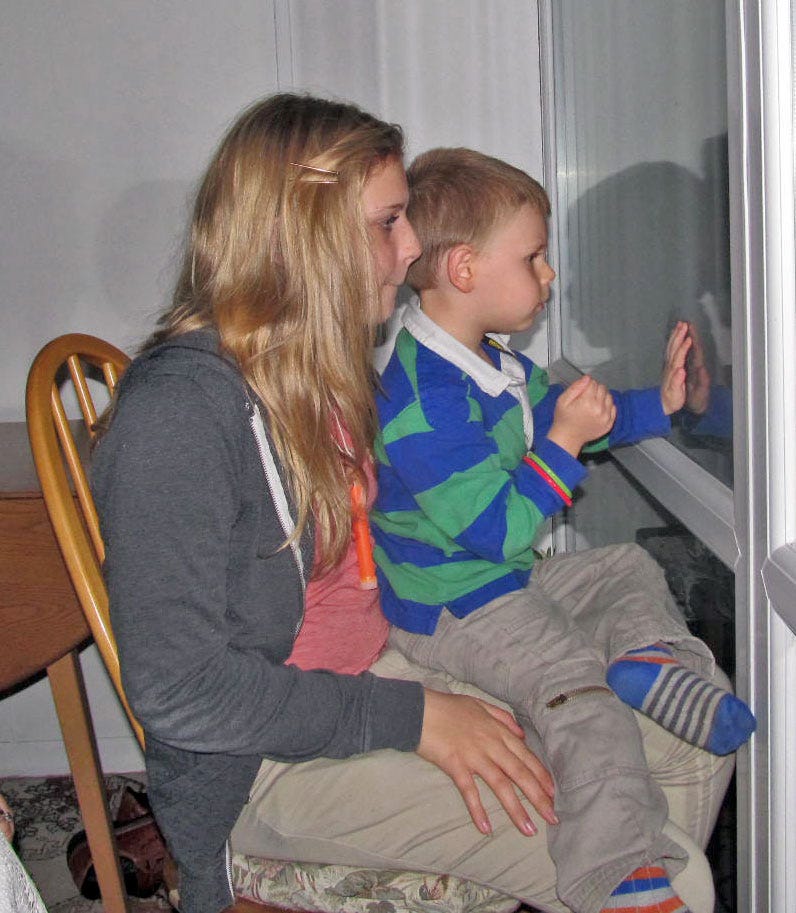
My son watching the 2011 fireworks with my niece
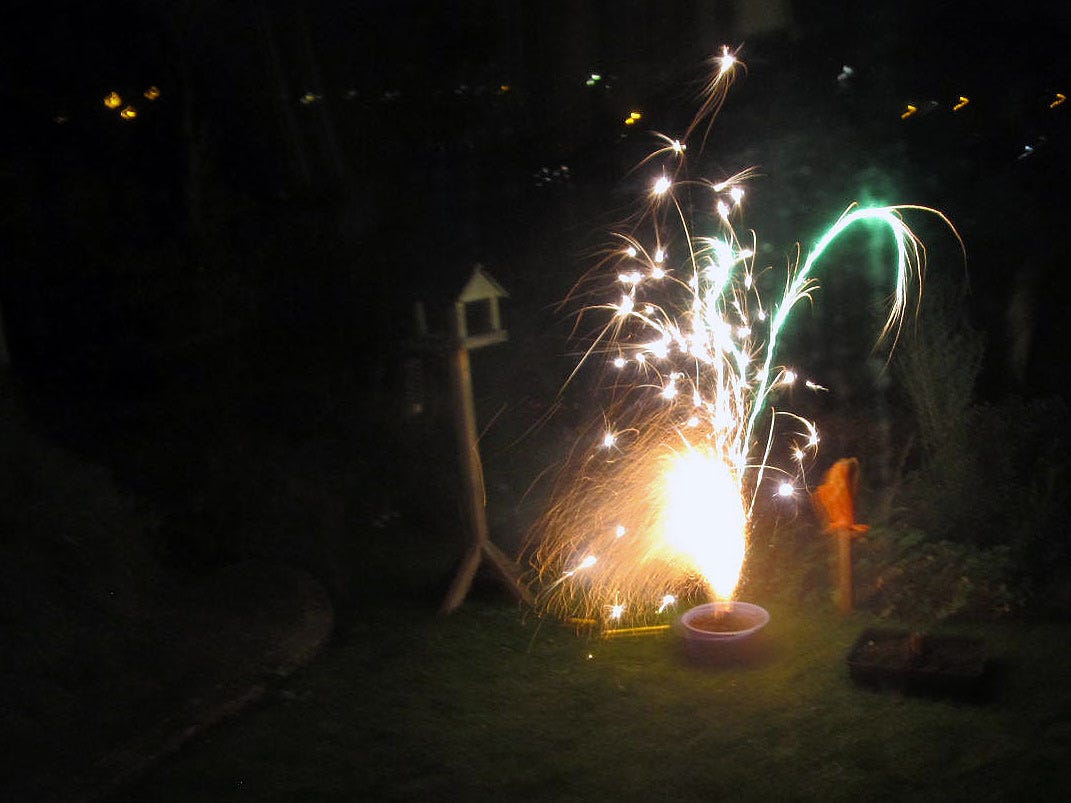
Action from our 2011 fireworks display. No birds were harmed in the making of this picture
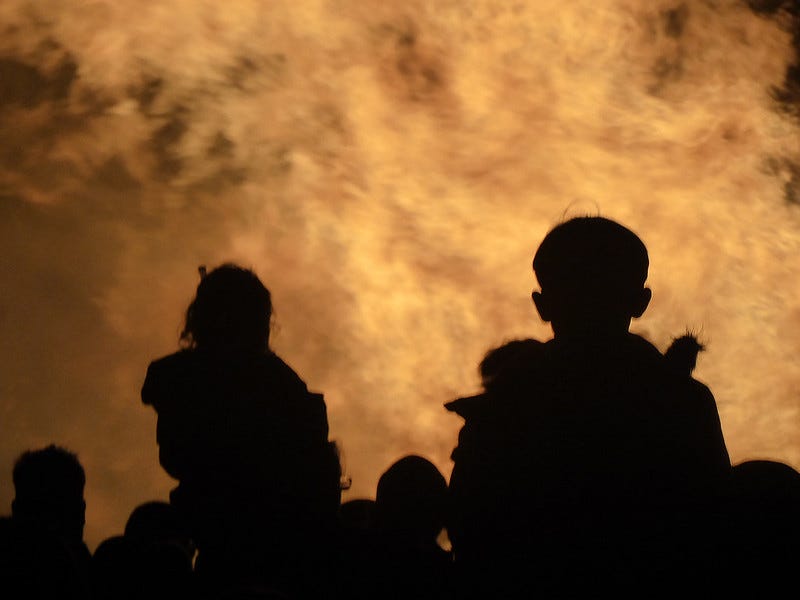
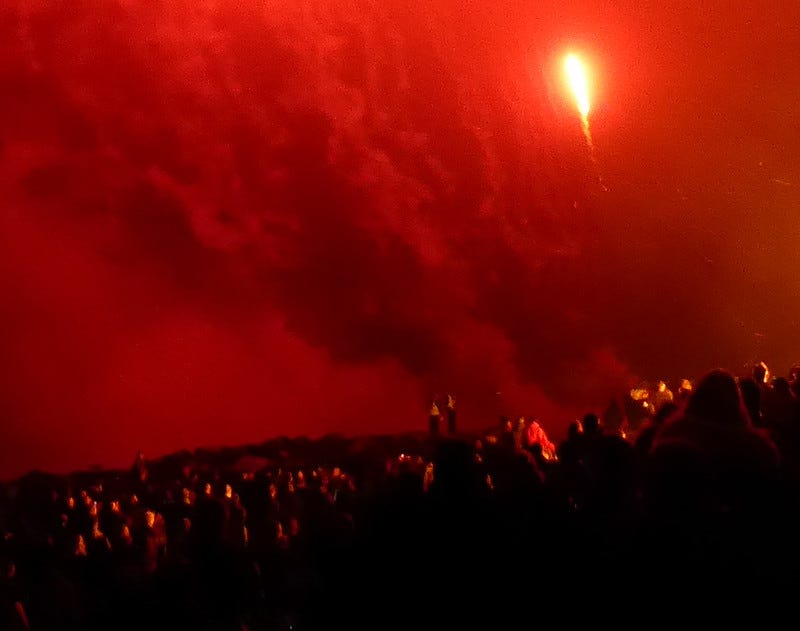
Because Guy Fawkes often coincided with half-term holidays, the displays being organised for the closest weekend to November 5th, I was still able to carry out my autumnal fireworks urge in my pre-covid, pre-stroke days. My brother took me to one at Worthing Rugby Club: very long, very attractive, ghastly music. But the last one I went to was at Shoreham Beach in 2016. I finish this tale with pictures from that evening which recapture something of the feral Guy Fawkes experience which I love.
A live programme in which viewers could try their skill at archery, sort of, mostly hosted by Bob Monkhouse who was an omnipresent TV host of the period.
Named after St Catherine of Alexandria, who was set to be executed on a (non-burning) wheel but caused it to disintegrate instead - she was just beheaded later.
It doesn’t get more 60s than that, does it?
An infamous extreme Protestant clergyman and politician from Northern Ireland